BIOMOUNT PROJECT
The project BioMount (Biodiversity patterns of Tyrrhenian seamounts) is part of the SIR programme. The Scientific Independence of young Researchers (SIR) programme (2014-2018) has been established by the Italian Ministry of Instruction, University and Research (MIUR) and is intended to enhance the independence of young researchers within the public institutions.
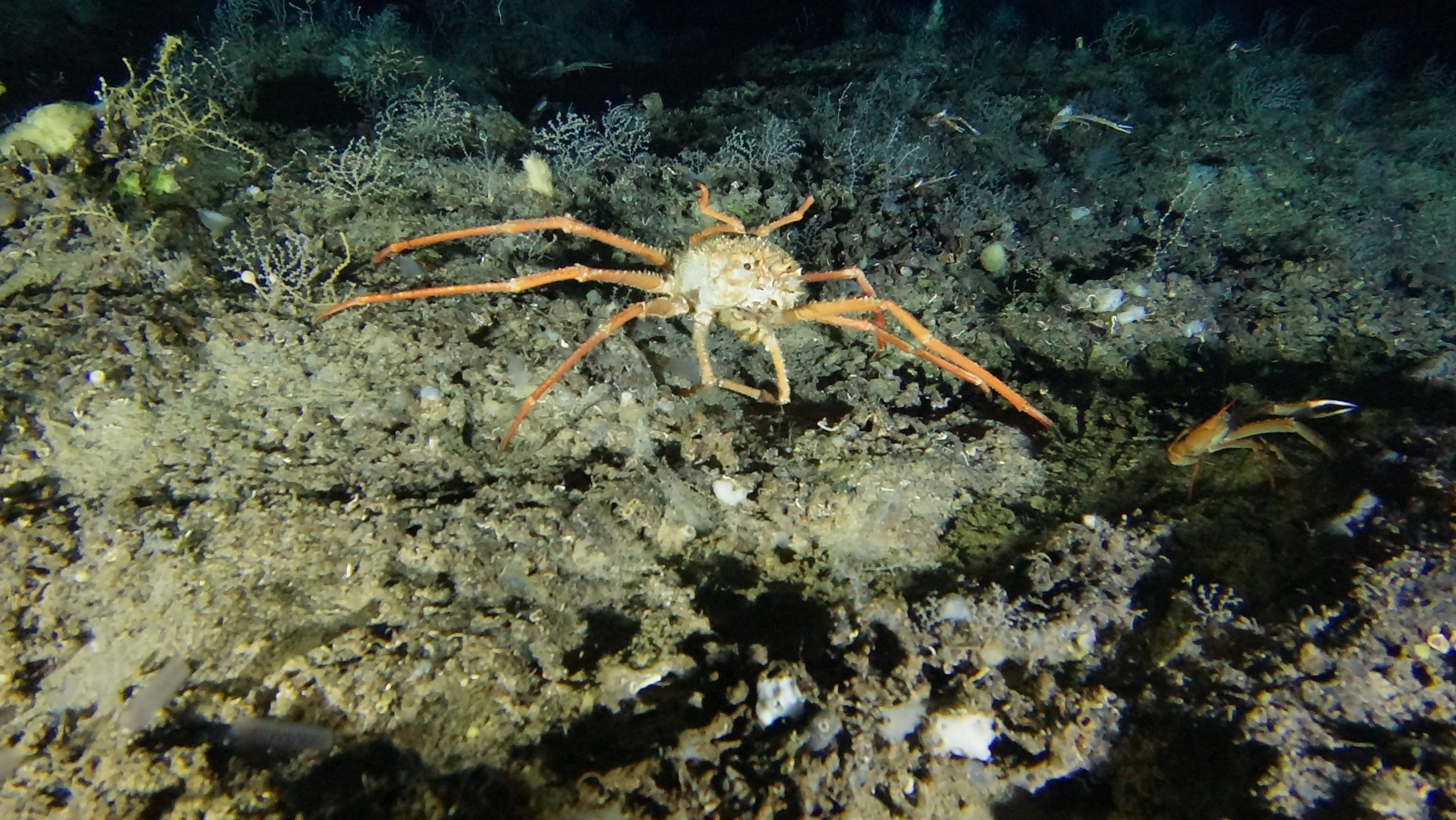
Seamounts are major topographic features found in all ocean basins and are defined as undersea mountains, mainly of volcanic origin, rising more than 100 m from the seafloor without breaking the sea surface. An abrupt topographic elevation, such as a seamount, over a flat deep bottom produces profound effects on the surrounding physical environment and, in turn, on the local dynamics of plankton, nekton and benthos trigger the establishment of lush assemblages mainly dominated of suspension feeders.
The Mediterranean Sea hosts about 1% of the total predicted large seamounts identified for the world's major basins. These underwater mountains have been relatively well investigated from the paleo-geological point of view, but very few data are available concerning the composition of their megabenthic and mesopelagic assemblages.
So far, biological information have been gathered for the Amendolara Seamount in the Ionian Sea, the summit of the Eratosthenes Seamount to the south of Cyprus, two shallow mounts in the Aegean Sea, four shallow seamounts along the Spanish coast, and three seamounts along the Sicilian coast reporting important cold water corals assemblages. Nevertheless, consistent information on the benthic fauna have been reported only for the Palinuro seamount in the South Tyrrhenian Sea, the so-called Stony Sponge Seamount in the Gulf of Valencia, and the Vercelli Seamount.
The Ligurian and Tyrrhenian bathyal plains are spotted by around 65 large and intermediate seamounts, which represents also the large majority of the Mediterranean mounts. While only two Tyrrhenian seamounts are considered shallow structures (Vercelli and Palinuro seamounts, showing peaks around 60-70 m depth where there is sufficient light for coralligenous communities to develop), all the other structures are considered deep mounts with peaks not exceeding 150 m depth.
The main task of the BioMount Project is to conduce a large-scale multi-disciplinary study on the biocoenoses of eleven Ligurian and Tyrrhenian seamounts targeting:
O1. To define, though a ROV survey, the biocoenotic characterization of the tops of the target seamounts divided among euphotic (<100m), mesophotic (100-200m), epibathyal (200-500m) or mesobathyal (>500m) depth ranges.
O2. To study the genetic variability of the coastal and seamount populations of the black coral Antipathella subpinnata and understand the role of seamounts as larval stepping-stones.
O3. To characterize the attracting effect of seamount for large predators and the occurrence of rich pelagic blooms
O4. To couple the biologic survey with a characterization of the topographic features of each target seamount and the overall water circulation pattern.
O5. To evaluate the human impact on the biocoenosis of the target seamounts, with the ultimate aim of suggesting a management plan for these habitats.
This multidisciplinary research approaches the study of eleven seamounts with tops ranging between 150 and 1900m following six work packages:
WP1. Background information collection for each study area
WP2. Coordination and planning of the field activities
WP3. The research will be carried out on board of the vessel Daedalus of AzioneMare. A first set of cruises has been carried out in the summer 2017 targeting most of the Ligurian seamounts; the Tyrrhenian mounts as well as the Ligurian deep Spinola Spur will be explored in the summer 2018. During each survey it will be possible to i) carry out the acquisition of Side-Scan Sonar profiles of the mounts and CTD profiles of temperature and salinity, and ii) make high-resolution video transects by means of a Multipluto ROV together with samples collection. Ecological experiments are carried out in three coastal Ligurian populations, including isotopic diet, microbial fauna (in collaboration with the Monaco Scientific Centre) as well as reproduction and growth rate observations (in collaboration with the Genoa Aquarium facilities).
WP4. Laboratory activity will be carried out including sorting and classification of the collected organisms and ROV-Imaging of all the video and photo material to assess benthic composition and occurrence of marine litter and fishing impact (2010/477/EU Decision, biological diversity, sea-floor integrity, properties and quantities of marine litter (descriptors 1, 6 and 10)). The genetic structuring between A. subpinnata populations will be assessed with the amplification of mitochondrial and/or nuclear regions to identify sequence and/or length polymorphisms.
WP5. Validation and analysis of the results.
WP6. Definition of a logistic-scientific protocol for the study, valorisation and management of the areas
The main expected result of the BioMount Project is the characterization, for the first time in the Ligurian and Tyrrhenian seas, of the biological assemblages of a series of deep seamounts so to provide important information on the real entity and composition of the communities they host and on the putative role of these structures as biodiversity attracting features also in higher levels of the trophic net.
The expected results of this project can be summarized as follows:
R1. Describe the deep biodiversity of Mediterranean seamounts
R2. Evaluate the role of filter feeders in the deep Pelagic-Benthic Coupling.
R3. Understand the degree of isolation of the coral fauna of Mediterranean seamounts.
R4. Evaluate the entity of the antropic impact on the benthic communities of each target seamount.
R5. Validate a scientific-logistic protocol for the study of seamounts in the Mediterranean Sea and propose a specific management plan for these vulnerable marine ecosystems integrating results from this study and data coming from previous explorations (Vercelli and Palinuro).