The Baronie Seamount extends N-S along the eastern Sardinian margin for about 100 km, and can be divided into three sectors: the northern and southern sectors have triangular shapes and reliefs of 1200 m and 950 m, while the central sector shows a N-S-rectilinear trend. It has two summit areas, at 162 m and 168 m water depth, characterized by a flat morphology and a thin sedimentary cover. The western flank of the Baronie Seamount, is the steeper one, averaging a dip of 27° in the northern sector and 13° in the southern sector. The Baronie is made of Variscan or older basement rocks, intruded by late Hercynian (about 300 Ma) granitoids, with thin, un-deformed Mesozoic cover characterized by Triassic lithotypes of ‘‘German facies’’ (Sartori et al., 2004). These rocks were not involved in the Alpine orogenic cycle, crop out along the backbone of the Baronie Seamount and at the Cornaglia Seamount, and are covered by Serravallian-early Tortonian to Pliocene-Pleistocene sediment (Sartori et al., 2004). Tethyan ophiolites, including their cover sequences have been sampled in the southeastern wing of the Baronie Seamount.
The Baronie Seamount represents an important ad exploited trawling ground for Mediterranean shrimps, in particular for Aristeus antennatus and Aristaeomorpha foliacea. A recent study conducted over the peak highlighted the occurrence of a rich benthic community, with the collection of 94 species, among which, 48 bony fishes, 9 cartilaginous fishes, 13 molluscs and 24 crustaceans (Sabatini et al., 2011). The seamount, due to its geomorphological conformation made of steep flanks and canyons, offers these species the opportunity to very quickly span a considerable range of depths (Sabatini et al., 2011).
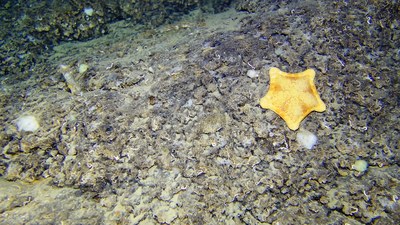
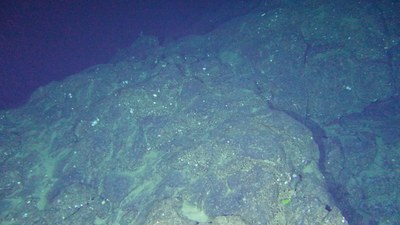
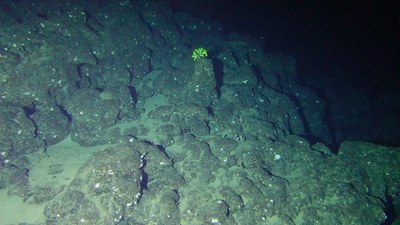
A recent ROV survey, conducted between 270 and 360 m water depth along the eastern flank of the mount, revealed the presence of sparse rocks, covered by a Fe and Mn crusts together with encrusting sponges and ascidians. The rocky habitat hosts cidarid sea urchins, holothurians, the sea star Peltaster placenta, various cnidarians (anemones and gorgonians) and the decapods Munida sp. and Plesionika sp. (Bo, pers. observ.).
The scleractinian Dendrophyllia cornigera was observed only dead both in the rocky conglomerates and on the sea bottom as sparse colonies. The observed fish assemblage included Helicolenus dactylopterus, Capros aper, Epigonus telescopus and various specimens of the shark Hexanchus griseus (Bo, pers. observ.).
Data from the Atlas of the Mediterranean Seamounts (Würtz & Rovere, 2015).