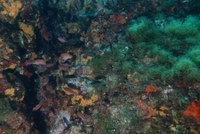
The Cialdi Seamount is a 36 km-long N-S oriented structural ridge, located 10 km to the east of the Etruschi Seamount in the northern Tyrrhenian Sea. It shows steep western and eastern sediment starved slopes, and reaches 345 m minimum water depth, at its flat top area. Here dredges recovered metamorphic rocks with green schist facies superimposed to blue amphibole facies, similar to the units of the Western Alps and Alpine Corsica (Fabbri et al., 1981). Dredge samples yielded calcareous hardgrounds between 1073 and 450 m and between 494 and 358 m, biogenic sands and pebbles (Wezel, 1981). The Cialdi Seamount is bounded eastward by a normal fault and may have rotated along it as a block, during the continental rifting and subsequent stretching of the eastern Tyrrhenian margin (Moeller et al., 2013). Rock samplings revealed numerous fossils, dominated by Gryphus vitreus and A. excavata (~8 cm), associated with Desmophyllum cristagalli, Stenocyathus vermiformis, Lophelia pertusa and large oysters. Rock surfaces were densely populated by Vermiliopsis monodiscus and Protula sp., which occur also as fossils within the rock (López Correa et al., 2005).
The high primary production area, surrounding Cialdi Seamount, supports many different shark and ray species (Cetorhinus maximus, Carcharhinus brachyurus, Hexanchus griseus, Alopias spp., Scyliorhinus canicula, Galeus melastomus, Etmopterus spinax, Raja clavata, Raja asterias). For most of them, this area acts as well as a nursery (Baino et al., 2010).
Data from the Atlas of the Mediterranean Seamounts (Würtz & Rovere, 2015).