
The Palinuro Seamount is a volcanic complex and consists of an array of volcanic edifices lying along an E-W fault system. At least eight single volcanic edifices can be recognised along the volcanic complex, their bases coalescing to form a near continuous volcanic ridge. The volcanic complex stretches for almost 50 km with a maximum width of 15 km at its base and rises to a minimum depth in its central part with two flat top volcanoes reaching 175 m and 84 m water depths (Marani and Gamberi, 2004). The 84-m peak is built on a small plateau 2 km in diameter, which is believed to be a marine terrace formed as a result of erosion during the last glacial lowering of sea level (Passaro et al., 2011). Palinuro is made up of basalts and basaltic andesites dated 0.8-0.35 Ma (Beccaluva et al., 1985).
To the west of the two shallower peaks, clusters of small cones surround a depressed area bordered by an arcuate northwestern ridge and smooth slope. This morphology could be related to a caldera-forming gravitational collapse event of a pre-existing volcanic edifice, followed by the creation of resurgent domes. To the east, a series of smaller cones develop, mostly exhibiting horseshoe morphology and cratered summits (Marani and Gamberi, 2004).
Massive sulfide deposits and hydrothermal Fe oxyhydroxide and manganese deposits, which have a potential commercial value for their metal content, were already sampled on Palinuro respectively at a depth of 631 m in the early ‘80s (Tufar, 1991) and as micronodules in the summit areas in the early ‘70s. Subsequent samplings recovered fragments of sulfide chimneys at a depth of 400-600 m occurring within craters and displaying Cu enrichments (Minniti and Bonavia, 1984).
In more recent years low-temperature hydrothermal venting was observed in the western summit of the volcanic complex at about 650 m water depth. Living siboglinid tube worm colonies were discovered and warm (60°C) native sulphur cemented sediments were recovered (Petersen et al., 2008). Although a magmatic SO2 contribution to the formation of the massive sulfides is likely, the activity of different sulphurrelated bacteria plays a role in their deposition, especially during late stage of ore formation (Peters et al., 2011). Hydrothermal active discharge was confirmed.
Only two ROV surveys are known for this peak. The first reported large areas of lithified and black-stained deep-water coral carbonate ledges interrupted by pelagic sediment drapes and fields of active hydrothermal crusts (Freiwald et al.,2011).
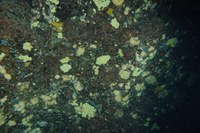
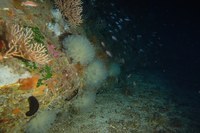
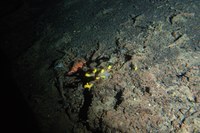
This activity was indicated by fissure fills of soft yellow sulphur and small black chimneys emanating hydrothermal water. No conspicuous hydrothermal metazoan fauna was detected. The only live colonial coral found was the yellow scleractian Dendrophyllia cornigera.
Another survey conducted on the shallower peak of the Palinuro Seamount, between 80 and 260 m depth, revealed the presence of interesting biocoenoses, in particular a shallow coralligenous assemblage (80-90 m) dominated by green and coralline algae and the crinoid Antedon mediterranea (Bo, pers. observ.). Numerous invertebrates were observed in this area, as the sponges Axinella spp., a dense population of Eunicella cavolinii, ceriantharians, hydroids, Sabella pavonina, Protula sp., Palinurus elephas, numerous Diazona violacea, Holothuria sp., Echinus melo, and various associated fish as Anthias anthias, Thorogobius ephippiatus, Serranus cabrilla, Aulopus filamentosus and Lappanella fasciata.
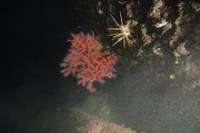
The rocky flanks between 100 and 260 m depth are characterized by various rocky elevations alternated with detritic slopes (Bo, pers. observ.). Here, the algal coverage progressively diminishes while the abundance of sponges (Axinella spp., Aplysina cavernicola, Pachastrella monilifera, Poecillastra compressa) increases. Various colonies of D. cornigera, Eunicella cavolinii, Acanthogorgia hirsuta, Corallium rubrum and Bebryce mollis were observed on the rocks together with a peculiar alcyonacean aggregation on the detritic slope. Only D. cornigera
and black coral assemblages (Leiopathes glaberrima and Parantipathes larix) were observed in the deepest explored range (Bo, pers. observ.). A high β-diversity of meiofauna was reported in the soft sediments around the Palinuro Seamount and was correlated to a diversification of the benthic food webs, suggesting that the presence of seamounts enhances the biodiversity in neighboring sediments (Pusceddu et al., 2009).
A high fishing impact was reported for this area, with dozens of lost long-lines found near the crest of the Seamount and numerous trawled and smashed colonies of D. cornigera (Freiwald et al., 2011).
A survey study on the spatiotemporal patterns of distribution of large predatory sharks carried out in the Calabrian waters showed the presence of differentshark species.
Data from the Atlas of the Mediterranean Seamounts (Würtz & Rovere, 2015).